
saphire-exim
Stripe Webhooks

Stripe Webhooks in Workadu
With the Stripe Webhooks integration, Workadu receives successful payments from Stripe and automatically creates the corresponding document, according to the series and settings you have selected.
This guide explains the setup, testing and the main checks you need to complete before enabling the live operation.
What you will need
- An active Workadu account — create a free account.
- An active Stripe account with access to the Developers section.
- AADE myDATA integration credentials, if you want to complete the document issuing and transmission flow.
- An active billing plan and provider integration, when required for your flow. For the initial tests, contact support to confirm the available settings.
How the integration works
- Stripe sends the successful payment event to the Workadu webhook endpoint.
- Workadu reads the available payment and Stripe Customer data.
- If a VAT ID is found on the Stripe Customer, an invoice is issued. If no VAT ID is found, a receipt is issued.
- The document series is selected based on the customer's country and whether a VAT ID exists, according to the series you have configured.
1. Create the webhook in Stripe
- Sign in to the Stripe Dashboard.
- Open Developers and then Webhooks or Event Destinations. The name may differ depending on your Stripe Dashboard version.
- Click Add endpoint or Add destination.
- Add the event
payment_intent.succeeded. - In Endpoint URL, temporarily enter https://workadu.com. You will need to change this field again later, in step 4.
- Save the endpoint.
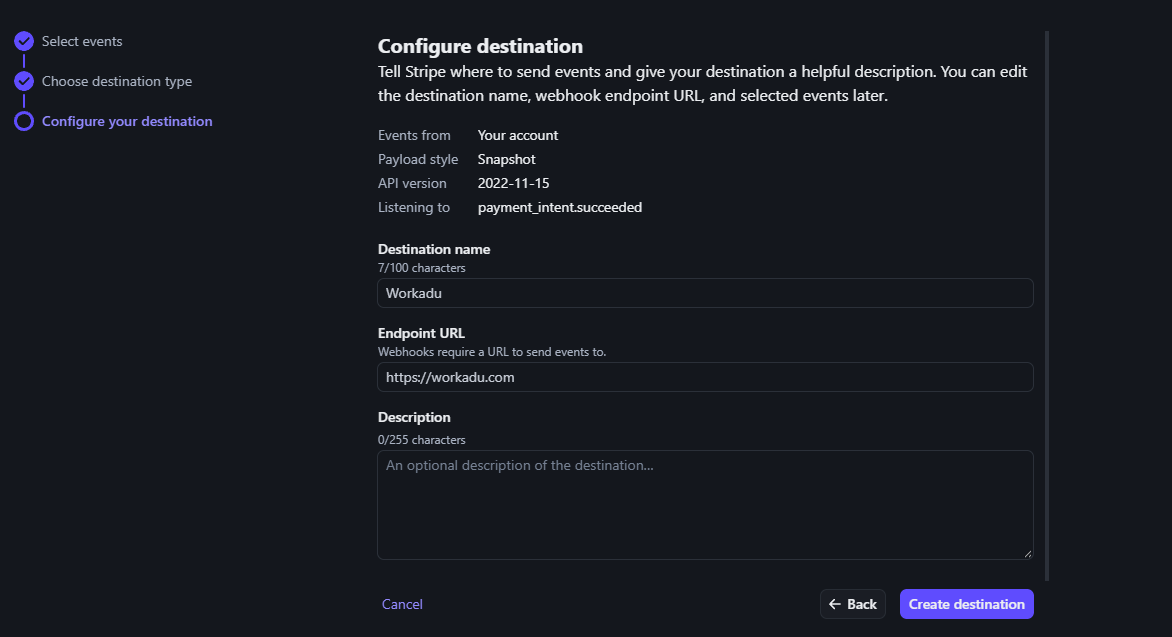
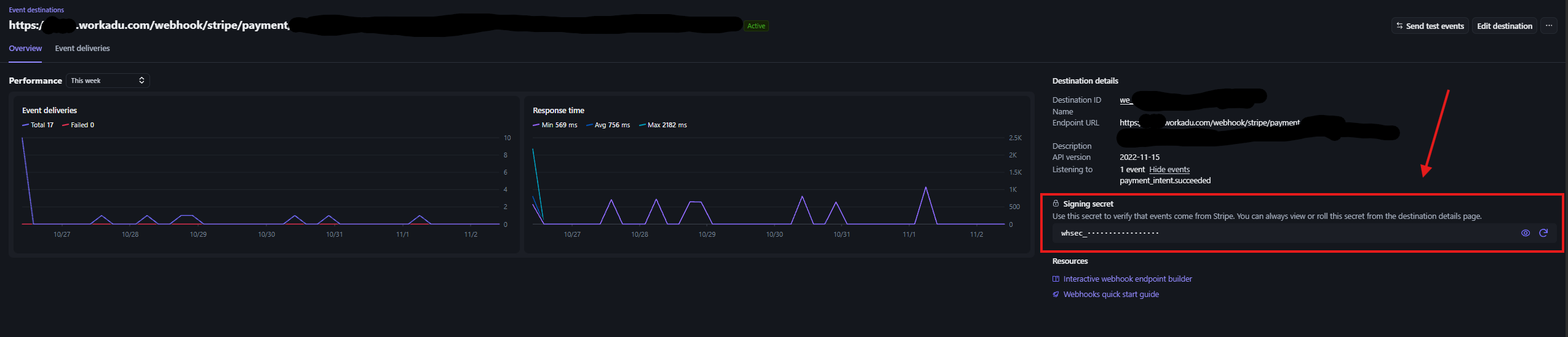
2. Copy the signing secret
Open the endpoint you created, find the Signing secret section and click Reveal. Copy the entire value without spaces at the beginning or end.
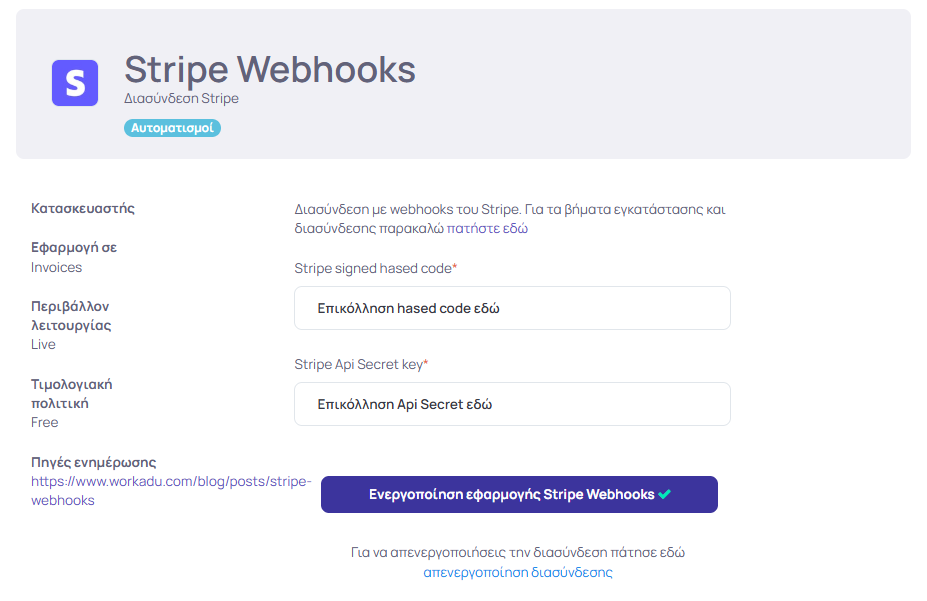
3. Connect Workadu
- Open Workadu.
- Click the puzzle icon at the bottom left and select Integrations.
- Open Automations, find Stripe Webhooks and click Connect.
- In Stripe signed hash code, paste the signing secret from the previous step.
- In Stripe API Secret key, paste the Secret key from Developers > API keys in Stripe.
- Then click Enable Stripe Webhooks application.
4. Copy the webhook URL from Workadu
On the same Stripe Webhooks integration screen in Workadu, find Register this webhook and copy the entire URL shown there. This is the integration's webhook URL, not the URL of the guide page.
Return to Stripe, open the endpoint you created, click Edit destination and in Endpoint URL replace the temporary https://workadu.com with the URL you copied from Workadu. Click Save.
5. Select document series
Select the document series that will be used and click Save and connect.
Select the appropriate series for each transaction category. Workadu uses the customer's country and whether a VAT ID exists on the Stripe Customer to select the appropriate series.
| Case | Series selected in the integration |
|---|---|
| Greece without VAT ID | Greek receipt webhook series |
| Greece with VAT ID | Greek B2B webhook series |
| European Union outside Greece without VAT ID | EU receipt webhook series |
| European Union outside Greece with VAT ID | EU B2B webhook series |
| Third country without VAT ID | Third-country receipt webhook series |
| Third country with VAT ID | Third-country B2B webhook series |
If the type or series you need is not available, contact support before enabling the integration.
6. Check and enable
To reduce the risk of accidentally sending a document to AADE, before testing you can open the account settings and temporarily add a space to the company's VAT number or remove one digit. After testing, restore the correct VAT number before going live.
- Confirm that the Stripe endpoint is active and uses the correct signing secret.
- Make a test payment and check in Workadu that the document was issued.
Testing without a real charge
You can test using Stripe test mode / sandbox, with the corresponding test API keys and webhook signing secret. Stripe test payments do not transfer real money.
Before going live
- Restore the correct VAT number in the account settings.
- Replace the test API keys and test signing secret with the live credentials, where required (the integration must be disabled and enabled again).
- Confirm the series, VAT, myDATA and provider settings with your accountant and support.
- Make one final controlled transaction and confirm that the document appears correctly in Workadu.
Frequently asked questions
When is an invoice issued and when is a receipt issued?
Workadu looks for a VAT ID on the Stripe Customer. If a VAT ID is found, an invoice is issued. If no VAT ID is found, a receipt is issued.
Where are the customer details obtained from?
When a Stripe Customer exists, its details are used. Alternatively, billing details are retrieved from charges.data[0].billing_details or from the Charge corresponding to latest_charge.
| Field | Stripe Customer | Charge billing details |
|---|---|---|
| Full name / business name | name | billing_details.name |
email | billing_details.email | |
| Phone | phone | billing_details.phone |
| Address | address.line1 | billing_details.address.line1 |
| City | address.city | billing_details.address.city |
| Postal code | address.postal_code | billing_details.address.postal_code |
| Country | address.country | billing_details.address.country |
How is the document series selected?
The selection is based on the customer's country and whether a VAT ID exists on the Stripe Customer. For this reason, you must complete the corresponding series in the integration.
The series selection fields are empty. What should I do?
If the integration works but the series selection fields are empty, you are probably using the older implementation. Contact Workadu support if you want to change the series or document routing.
Where does the product or service description come from?
For Checkout line items, the integration reads the description field of each line. In the payload it appears as line_items.data[].description, while the Stripe line-items endpoint returns it as data[].description. If there are no Checkout line items, the integration uses data.object.description from the PaymentIntent. If that is also empty, it uses the default description of the first series line in Workadu.
How does VAT by country and OSS work?
For transactions to a customer in an EU country other than Greece, when a series that supports OSS is used, the integration reads the tax rate attached to the Stripe Checkout line and stores it as OSS VAT together with the country of consumption.
The net value is calculated from the line amount and the rate sent by Stripe. For example, when Stripe has calculated 19% for a private customer in Germany, the document breakdown uses the German rate rather than the Greek 24% rate.
For different rates by country, the tax information must be configured correctly in Stripe, usually through Stripe Tax. If Stripe does not send a tax rate, the default tax configuration of the Workadu series or account is applied.
For OSS series, Workadu keeps the country and OSS rate for the document breakdown and the related tax transmission. Stripe Tax documentation for Checkout
What happens if Stripe sends the same payment again?
Workadu keeps the payment's unique ID and does not create a duplicate document for the same payment.
What should I check if a test does not complete?
Check that you are using test credentials with a test endpoint or live credentials with a live endpoint, that the event has been added to the webhook and that the Workadu integration was saved with the correct signing secret. If the issue continues, contact support.
Related posts
saphire-exim
Will a myDATA Integration Slow Down My WooCommerce Checkout?
saphire-exim
Do I Need myDATA If I Already Use Stripe Invoicing or Stripe Tax?
saphire-exim
Is Shopify Already myDATA Compliant? What Greek Sellers Need to Know
saphire-exim
WooCommerce to myDATA Integration: Automatic Invoicing Without Plugins
saphire-exim
Stripe to myDATA Integration: Turn Payments into Compliant Invoices
saphire-exim
Shopify to myDATA Integration: Automatic Invoicing for Greek E-Shops
saphire-exim
Novus Conceptus
 saphire-exim
Impact
 saphire-exim
Eventbrite webhook
 saphire-exim
EFT POS
 saphire-exim
Woocommerce webhook
 saphire-exim
Viva Webhook